

Table of Contents
- Understanding Suspension Geometry and Articulation for Off-Road Mastery
- Spring Rates and Shock Absorbers: The Foundation of Your Setup
- Best Suspension for Rock Crawling: Maximum Articulation and Travel
- Off-Road Suspension Setup for Daily Driver: Balancing Comfort and Capability
- Overlanding Suspension Upgrades: Endurance Over Distance
- Suspension Tuning for High-Speed Off-Roading: Valving and Adjustability
- Essential Suspension Upgrades and Maintenance for Longevity
- Budget-Friendly vs. Performance Setups: What You Actually Need
- Frequently Asked Questions
Last Updated: October 12, 2026
Understanding Suspension Geometry and Articulation for Off-Road Mastery
The best suspension setup for off roading starts with geometry. Camber, caster, and toe determine whether your rig climbs a rock face or gets hung up on it.
Get these three angles wrong and even the most expensive shocks won't save you. Get them right and a modest lift kit outperforms a poorly tuned premium system.

How Camber, Caster, and Toe Affect Trail Performance
Camber is the angle of your wheel relative to vertical.
Caster is the forward or backward tilt of your steering axis.
Toe is the angle of your wheels relative to the centerline.
A vehicle with poor geometry fights you on every climb: control arms bind, drivelines angle too far, tires lose contact.
Independent vs. Solid Axle Suspension Trade-Offs
Independent front suspension (IFS) uses two separate control arms per wheel, allowing each side to move independently.
Solid axle suspension (also called live axle) connects both wheels on one rigid beam.
For best suspension setup for off roading, the choice depends on terrain and driving style.
Spring Rates and Shock Absorbers: The Foundation of Your Setup
Spring rate is the force required to compress your suspension one inch.
Most factory springs are tuned for highway comfort with light loads. Lift kits include new springs engineered for increased ride height and adjusted rates.
Shock absorbers control how quickly the spring compresses and extends.
Coilovers vs. Leaf Springs for Different Terrain
Coilovers (coil springs over shock absorbers) are the modern standard.
Leaf springs are stacked metal leaves. They're simple, durable, and handle heavy loads exceptionally well.
For rock crawling and technical terrain, coilovers win. For overlanding with heavy loads or desert high-speed running, leaf springs or a hybrid setup (coilovers front, leaf springs rear) performs better.
Dampening, Rebound, and Compression Control
Compression dampening resists the spring as it compresses when you hit an obstacle. Rebound dampening resists the spring as it extends.
High compression dampening feels stiff and controlled, good for high-speed or heavy-load situations. Low compression dampening absorbs impacts more easily, better for technical rock crawling where you need compliance.
Best Suspension for Rock Crawling: Maximum Articulation and Travel
Rock crawling demands maximum articulation, the suspension travel available when wheels flex up and down independently.
The best suspension setup for off roading in rock crawling prioritizes articulation over ride comfort. Long-travel coilover kits with 4-6 inches of lift provide the clearance and travel needed.
Long-Travel Suspension Systems and Bump Stops
Long-travel suspension extends compression and extension beyond factory limits. A typical factory suspension might have 8 inches of total travel; a long-travel kit can double this to 16+ inches.
Bump stops prevent the suspension from bottoming out completely. They compress progressively, starting soft and getting stiffer, cushioning the final inches of travel.
Control Arms and Driveline Angles
Control arms link the wheel hub to the chassis, controlling wheel movement and maintaining suspension geometry. Long-travel kits use upgraded control arms, typically forged aluminum with reinforced ball joints and bushings. When you lift a vehicle, factory control arms change angle, altering camber and caster.
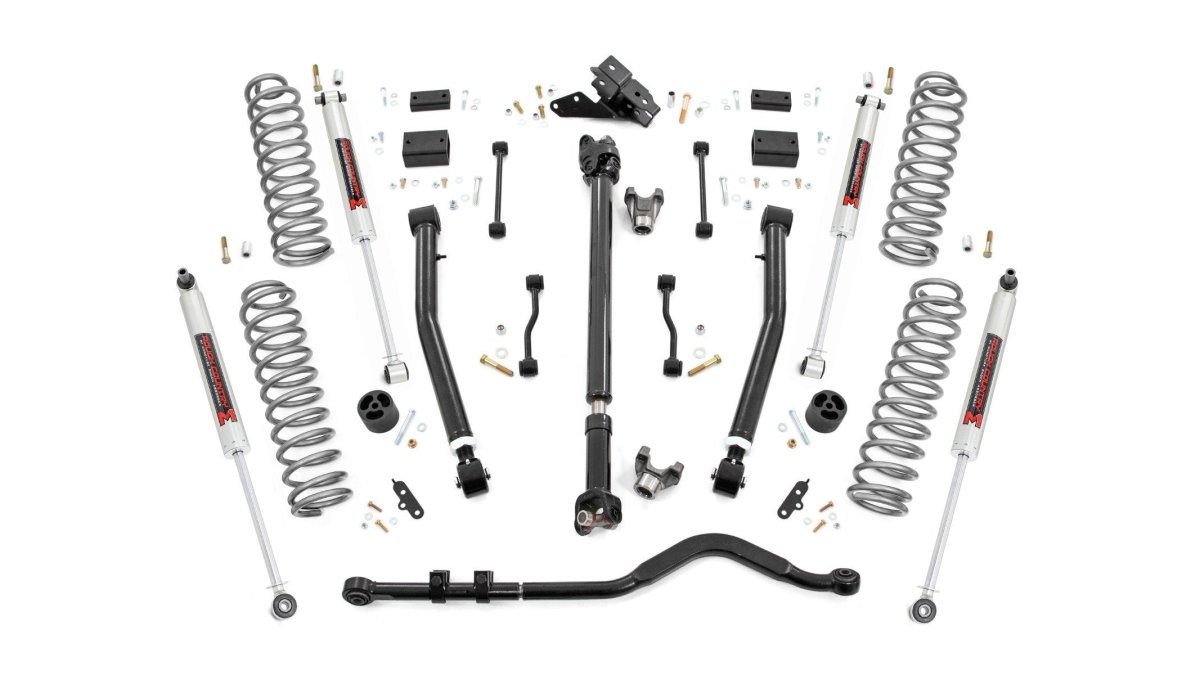
Driveline angles become critical in lifted vehicles. THE SUSPENSION SPECIALISTS includes extended driveshafts in some of our lift kits, for example, the 3.5 Inch Lift Kit | Adj Lower | FR D/S | M1 | Jeep Wrangler JL 4WD (2024-2025) ($1,489.95) and the 3.5 Inch Lift Kit | C/A Drop | FR D/S | Jeep Wrangler JL 4WD (2024-2025) ($1,249.95) both feature an extended front CV driveshaft specifically designed to maintain clearance during full articulation.

Off-Road Suspension Setup for Daily Driver: Balancing Comfort and Capability
Many drivers want a capable vehicle that still rides well on the highway. This requires balancing lift height, spring rates, and damping to deliver both capability and comfort.
A daily-driver best suspension setup for off roading typically uses a modest 2-3 inch lift with moderate spring rates and balanced dampening.
Choosing Lift Height Without Sacrificing Ride Quality
Lift height directly impacts ride quality. Each inch of lift changes suspension geometry, increases center of gravity, and shifts weight distribution.
For daily drivers, 2.5-3 inches is the sweet spot. The 2.5 Inch Lift Kit | Coils | N3 | Jeep Wrangler JL 4WD (2024-2025) ($489.95) delivers capability without sacrifice.
Highway Stability and Handling on Lifted Vehicles
Lifting a vehicle raises its center of gravity, increasing body roll in corners and reducing stability in emergency maneuvers.
Tire choice matters significantly. Wider, heavier tires increase unsprung weight and reduce handling precision.
Alignment is essential. Factory alignment specs don't apply to lifted vehicles.
Overlanding Suspension Upgrades: Endurance Over Distance
Overlanding, traveling long distances on mixed terrain with camping gear, demands different priorities than rock crawling or daily driving.
Overlanding suspensions typically use 3-4 inch lifts with stiffer spring rates than daily drivers but softer than rock crawlers. The goal is maintaining ride height under load while delivering compliance for rough terrain.
Payload Capacity and Load-Carrying Geometry
Payload capacity is the maximum weight your vehicle can safely carry. Factory suspensions are tuned for light loads.
Spring rate determines how much the suspension compresses under load. Too soft and you compress the suspension fully, reducing ground clearance and handling.
Add-a-leaf kits (additional leaf springs) and rear blocks increase rear spring rate without replacing the entire suspension, popular overlanding upgrades for vehicles with leaf spring rear suspensions.
THE SUSPENSION SPECIALISTS carries kits with load-rated components. The 5-inch Ford Bronco kit ($2,549.95) with optional M1R monotube struts manages both light and heavy loads while maintaining geometry.
Sway Bars and Anti-Roll Bar Setup for Stability
Sway bars resist body roll during cornering and when traversing side slopes.
3.5 Inch Lift Kit | Adj Lower | FR D/S | M1 | Jeep Wrangler JL 4WD (2024-2025) →
Front sway bars are standard on most vehicles. Rear sway bars are optional and less common.
Sway bar disconnects allow you to decouple the sway bars during off-road driving, allowing more independent wheel movement.
Suspension Tuning for High-Speed Off-Roading: Valving and Adjustability
High-speed off-roading, desert running, dune bashing, fast trail driving, demands different suspension tuning than rock crawling.
High-speed off-roading requires stiffer springs, stiffer dampening, and carefully tuned shock valving. The suspension must resist compression to prevent bottoming, then rebound quickly to maintain tire contact for the next impact.
Nitrogen-Charged Shocks and Monotube Design
Nitrogen-charged shocks use pressurized nitrogen gas separated from the damping fluid by a piston.
Monotube shocks have a single piston rod moving through a single chamber.
Digressive valving means the shock's dampening changes as compression speed increases. At low speeds, the shock is compliant.
THE SUSPENSION SPECIALISTS offers M1R premium monotube shocks with external reservoirs and digressive valving. The 5 Inch Lift Kit | M1R | Ford Bronco 4WD (2021-2025) ($2,549.95) with optional M1R monotube struts delivers this level of performance.

Ride Height Adjustability and Digressive Valving
Some premium shocks include ride height adjustability, you can change the shock's compression point without changing the spring.
Digressive valving combined with adjustability delivers maximum flexibility. You can tune the suspension for your specific terrain and load, then adjust on the fly if conditions change.
Essential Suspension Upgrades and Maintenance for Longevity
A quality lift kit is the foundation, but supporting components determine real-world durability. Track bars, bushings, driveshafts, and tie rods all change when you lift a vehicle. Neglecting these upgrades leads to premature wear, handling issues, and component failures.
Track Bars, Bushings, and Control Arm Durability
Track bars (also called panhard bars) connect the axle to the chassis, controlling side-to-side movement. Factory track bars are designed for stock height.
Bushings are rubber or polyurethane components that isolate metal-to-metal connections, absorbing vibration and allowing controlled movement. Factory bushings wear out under the stress of lifting.
Control arms (upper and lower) link the wheel to the chassis. The 3.5 Inch Lift Kit | Adj Lower | FR D/S | M1 | Jeep Wrangler JL 4WD (2024-2025) ($1,489.95) and the 3.5 Inch Lift Kit | C/A Drop | FR D/S | Jeep Wrangler JL 4WD (2024-2025) ($1,249.95) both feature a heavy-duty track bar constructed from forged solid steel with 1.25-inch outside diameter and OEM-style rubber bushings, components that survive years of aggressive off-road use.
Tire Clearance and CV Driveshaft Compatibility
Tire clearance is the space available for tires without rubbing on suspension or body components. Each lift height allows a specific maximum tire size.
CV driveshaft compatibility is critical in lifted vehicles. Factory driveshafts have limited articulation.
THE SUSPENSION SPECIALISTS specifies tire clearance and driveshaft requirements for each kit.
Long-Term Cost of Ownership and Warranty Protection
A quality lift kit costs more upfront but delivers lower long-term costs.
Warranty protection matters. Some kits are backed with a limited lifetime replacement warranty towards manufacturer defects.
Installation costs vary. Bolt-on kits can be installed at home with basic tools in 4-6 hours.
| Maintenance Item | Interval | Cost Impact | Durability Factor |
|---|---|---|---|
| Shock fluid replacement | 40,000-60,000 miles | Moderate | Extends shock life significantly |
| Bushing inspection/replacement | 60,000-80,000 miles | Moderate | Prevents geometry drift and noise |
| Driveshaft inspection | 30,000 miles | Low | Catches wear before failure |
| Alignment check | 20,000-30,000 miles | Moderate | Prevents tire wear and handling issues |
| Spring inspection | 100,000+ miles | Low | Detects fatigue cracks early |
Budget-Friendly vs. Performance Setups: What You Actually Need
The suspension market offers options from $122 entry-level kits to $3,500+ premium systems. The difference isn't always value, sometimes a mid-range kit delivers better real-world performance than the cheapest option, and sometimes the most expensive kit is overkill for your actual use case.
Entry-Level Lift Kits vs. Premium Coilover Systems
Entry-level kits (under $600) typically use basic coil springs or torsion key adjustments with modest lift (2-3 inches) and stock or minimal shock upgrades.
Performance coilover systems (over $2,000) use high-quality coil springs, nitrogen-charged or monotube shocks with adjustable dampening, and often include ride height adjustability.
The middle ground, $800-1,500 kits with quality coil springs and mid-range shocks, often delivers the best value. The 3.5 Inch Lift Kit | Red UCA | M1 Struts | Toyota Tacoma 2WD/4WD (2005-2023) ($1,119.95) with forged aluminum control arms and configurable shocks exemplifies this approach.
Vehicle-Specific Weight Distribution Analysis
Different vehicles have different weight distributions.
When selecting a suspension kit, consider your vehicle's baseline weight distribution and your typical load pattern.
THE SUSPENSION SPECIALISTS specifies spring rates and component options for each vehicle and use case.
Choosing the best suspension setup for off roading requires understanding your terrain, vehicle, and actual use case.
THE SUSPENSION SPECIALISTS has been helping customers dial in the right suspension since 2005. Whether you're lifting a classic Chevy S10 or a modern Bronco, we have the parts to get your suspension right. Add to cart and start your upgrade today.
Frequently Asked Questions
What is the best suspension setup for off-roading?
The best suspension setup depends on your terrain and driving style. For rock crawling, prioritize long-travel suspension with high articulation and nitrogen-charged shocks for dampening control. For overlanding, focus on payload capacity and stable geometry. For daily drivers, choose a lift kit with tuned coil springs that balances ground clearance with highway ride quality. Independent suspension (IFS) offers better articulation on rocky terrain, while solid axle setups provide simplicity and durability. Most off-road builds use 2.5 to 5-inch lift kits paired with adjustable shocks and reinforced control arms.
Can an off-road suspension setup still ride well on the highway?
Yes, modern lift kits designed for daily drivers can maintain highway comfort. The key is choosing coil springs with OEM-tuned spring rates and nitrogen-charged shocks with proper dampening valving. A 2.5 to 3.5-inch lift with linear coil springs preserves ride quality better than extreme lifts. Sway bars and anti-roll bars reduce body roll on curves. Many owners report minimal highway impact when using quality components like those found in bolt-on kits. Avoid oversized tires and maintain proper wheel alignment to preserve handling and tire wear.
What makes shock absorbers critical for off-road suspension tuning?
Shock absorbers control compression and rebound, how your suspension responds to impacts and terrain variation. Nitrogen-charged shocks prevent fade under repeated impacts and maintain consistent dampening on long trails. For high-speed off-roading, digressive valving adjusts damping force as suspension velocity increases, preventing bottoming out. Monotube shocks with external reservoirs offer greater oil capacity and heat dissipation, extending shock life. Choosing the right shock type, N3 nitrogen-charged for balanced rides, M1 monotube for performance, or M1R with adjustability, directly affects control, articulation, and durability.
How do I know which lift kit height is right for my vehicle?
Lift height depends on terrain and tire size. A 2.5-inch kit suits daily drivers and light off-roading with 33-inch tires. A 3.5-inch lift handles moderate trails and 35-inch tires while maintaining drivability. A 4.5 to 6-inch lift is for serious rock crawling and overlanding, supporting up to 37-inch tires but requiring careful geometry management. Consider your vehicle's weight distribution, payload needs, and whether you need front-to-rear leveling to eliminate factory nose-down stance. Older vehicles like the Jeep Cherokee XJ (1984-2001) may use add-a-leaf springs for rear support, as seen in our 4.5 Inch Lift Kit | M1 | Rear AAL | Jeep Cherokee XJ 2WD/4WD (1984-2001) ($709.95), while newer models often use coil spring systems for better tuning.
What is the difference between independent and solid axle suspension for off-roading?
Independent front suspension (IFS) offers better articulation and compliance on rocky terrain, allowing wheels to move independently and maintain traction. Solid axles are simpler, more durable, and better for heavy loads and extreme articulation. IFS vehicles typically use MacPherson struts or double wishbone geometry with control arms and bushings. Solid axle setups use leaf springs or coils with track bars and control arms. For rock crawling, IFS excels; for overlanding with heavy payloads, solid axles provide better load-carrying geometry. Most modern trucks use IFS or IRS (independent rear suspension), while classic trucks and Jeeps use solid axles.
How do I choose between coilovers and leaf springs?
Coilovers offer ride height adjustability, better handling, and tunable spring rates, making them ideal for high-speed off-roading and daily drivers. Leaf springs are simpler, more durable under extreme loads, and better for overlanding with heavy gear. Coilover conversion kits, such as our 6 Inch Lift Kit | Gas | 4 Link | OVLD | C/O Vertex | Ford F-250/F-350 Super Duty (05-07) ($3,509.95), replace factory coil-shock setups with adjustable 2.5-inch piston monotube shocks and external reservoirs, providing fade-free control. Leaf spring add-a-leaf kits restore rear suspension strength without replacing the entire system. Most modern vehicles come with coil springs; choose coilovers if you want adjustability, leaf springs if you prioritize simplicity and load capacity.
What is articulation, and why does it matter for rock crawling?
Articulation is how much your suspension can flex and compress when wheels encounter obstacles. High articulation means wheels can travel further vertically while the chassis stays level, maintaining traction on uneven terrain. Long-travel suspension systems with 4 to 6 inches of wheel travel maximize articulation for rock crawling. Bump stops limit extreme compression, protecting components from damage. Control arm geometry and driveline angles affect articulation; poor angles cause CV joint damage when suspension is fully flexed. Vehicles with high articulation can maintain tire contact on rocky terrain, preventing loss of traction and reducing risk of rollover.
