

Table of Contents
- Why Heavy Duty Towing Destroys Standard Shocks
- Best Suspension Upgrades for Towing: Quick Comparison
- Rancho RS5000X: Best for 2017-2020 Ford Super Duty
- Rough Country N3 Shocks: Best Value for Multiple Lift Heights
- Adjustable Shock Absorbers for Towing: When They Make Sense
- Shock Absorber vs Air Helper Springs for Towing
-
How to Choose Durable Shocks for Heavy Duty Towing
- Step 1: Measure Your Current Lift Height
- Step 2: Confirm Your Drivetrain
- Step 3: Estimate Tongue or Pin Weight
- Step 4: Decide on Adjustment
- Step 5: Check the Warranty and the Heat Spec
- Step 6: Match Front and Rear
- The Gap Most Guides Miss: Electronic Suspension Integration
- The Other Gap: Environmental Exposure
- A Practical Shortlist
- Frequently Asked Questions
Last Updated: October 4, 2026
Why Heavy Duty Towing Destroys Standard Shocks
Factory shocks are valved for an empty truck on smooth pavement. Add a trailer and the math changes immediately. Durable shocks for heavy duty towing matter because the load never stops working against the suspension, and the failure modes are predictable.
The Load Math
A bumper-pull trailer places 10-15% of its gross weight on the tongue, so a 7,000 lb trailer adds roughly 700-1,050 lb over or slightly behind the rear axle.
The rear axle doesn't just carry more weight. It carries it in a position the suspension was never tuned for.
Heat: The Real Killer
Shock absorbers convert kinetic energy into heat as fluid is forced through valving orifices. Every bump, expansion joint, brake dive and acceleration squat cycles the piston and generates heat. Towing multiplies the energy input because:
- The trailer's mass adds inertia the suspension must control on every input.
- Tongue or pin weight keeps the rear springs compressed, reducing travel and forcing the shock to work harder within a shorter stroke.
- Trailer sway and porpoising pump heat into the fluid faster than airflow can remove it.
As fluid temperature rises, viscosity drops (pubmed.ncbi.nlm.nih.gov). Damping force falls off, the gas charge loses pressure, and aeration can occur, the fluid foams and the shock stops damping predictably. That's when you feel trailer sway, wallowing over bridge joints, and a rear end disconnected from the road.
Geometry and Center of Gravity
Towing raises the center of gravity and shifts weight rearward, changing control arm angles, pinion angle, and the effective motion ratio at the shock. A shock valved for a stock, unladen truck now operates outside its design window, planted empty, but vague and floaty at highway speed with a loaded trailer.
Hitch Type Changes the Shock Requirement
Bumper-pull and fifth-wheel/gooseneck setups load the rear suspension differently:
- Bumper pull: Tongue weight sits behind the rear axle, which acts as a lever. The rear axle sees more load than the tongue weight alone suggests, and the front axle can unload slightly. Shocks must control both added rear compression and reduced front grip.
- Fifth wheel / gooseneck: Pin weight sits over or slightly ahead of the rear axle. The rear axle carries the load more directly, the front axle stays loaded, and sway is inherently lower. The shock requirement shifts toward controlling heavy compression and rebound without excessive stiffness that would make the unloaded truck harsh.
A shock that works well for a 6,000 lb bumper-pull camper isn't automatically right for a 14,000 lb fifth wheel. The load path, sway behavior, and heat generated per mile are different.
What This Means for Shock Selection
Durability under towing isn't about a single spec. It's the combination of:
- Enough fluid volume and body diameter to manage heat.
- Velocity-sensitive valving that ramps damping force as piston speed increases, so light inputs stay comfortable and hard hits get controlled.
- A gas charge that resists fade and aeration under sustained load.
At THE SUSPENSION SPECIALISTS, we match aftermarket suspension parts to how trucks actually get used. The pattern is consistent: towing punishes shocks never sized for the load, showing up first as heat fade, then uncontrolled motion, then seal failure.
Best Suspension Upgrades for Towing: Quick Comparison
The best suspension upgrades for towing fall into three groups: gas-charged performance shocks, adjustable shocks, and load-supporting helpers like air-assist springs.
| Option | Starting Price | Best For | Key Strength |
|---|---|---|---|
| Rancho RS5000X Gas Shocks Set | $303.60 | 2017-2020 Ford F-250/F-350 4WD | Ten-stage velocity-sensitive valving |
| Rough Country N3 Shocks | $119.95 | Multiple lift heights, F-250/F-350 | 54mm body for heat dissipation |
| Adjustable shock absorbers | Varies by application | Mixed daily driving and towing | Tune damping to the load |
| Air helper springs | Varies by application | Constant heavy tongue weight | Restores ride height under load |
A common mistake is buying one category and expecting it to fix everything. Shocks control motion. Springs and air helpers carry weight. If your truck squats hard with a trailer attached, better shocks alone won't level it.

Rancho RS5000X: Best for 2017-2020 Ford Super Duty
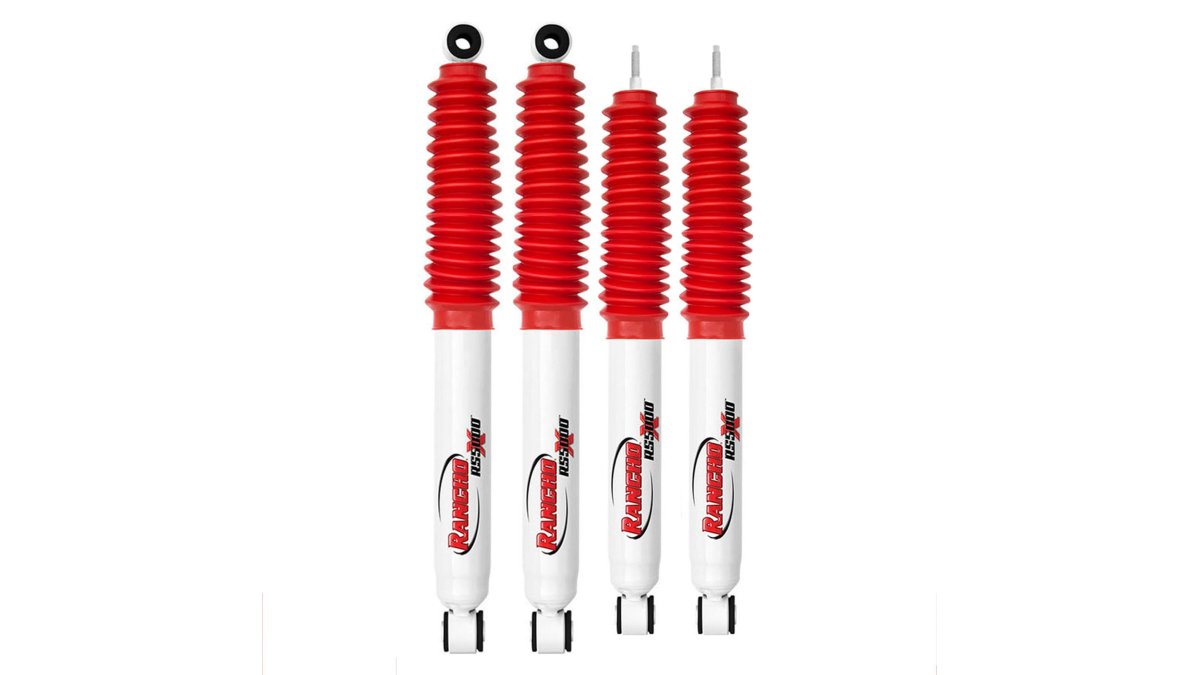
For 2017-2020 Ford F-250 and F-350 4WD owners, the Rancho RS5000X Gas Shocks Set is our top pick for trailer duty.
Specs and Towing Performance
The RS5000X runs ten-stage velocity-sensitive valving, so damping force adjusts automatically as the piston moves faster. Light inputs stay comfortable; hard hits from a loaded trailer get controlled instead of bounced.
The set ships with front and rear shocks.
Pros and Cons
Pros:
- Ten-stage velocity-sensitive valving handles variable loads well
- Complete front and rear set with dust boots included
- Same-day shipping when ordered by the cutoff
Cons:
- Designed for 0-2" lift kits, so it won't suit taller lifted trucks
- Requires a 4WD/4X4 model
Rough Country N3 Shocks: Best Value for Multiple Lift Heights
If you need a specific lift height covered, the Rough Country N3 line is the practical answer. Front and rear N3 shocks start at $119.95.

Specs and Towing Performance
Every N3 shock uses 10-stage variable valving and a high-pressure nitrogen charge for consistent damping. The 18mm chromed hardened piston rod resists corrosion, and the 54mm body dissipates heat to prevent fade during long pulls.
Tensile strength sits at 36kN, and the military-spec fluid is rated to -40 degrees Celsius, so cold-weather towing doesn't degrade performance. Natural rubber bushings cut vibration and noise.
Pros and Cons
Pros:
- Front and rear options from 0-1.5" up to 7.5-8" lift heights
- Heat-dissipating 54mm body reduces shock fade under load
- Backed by a 3-year manufacturer's warranty
Cons:
- Fixed valving means no on-the-fly adjustment for changing loads
- Lift height must match your existing setup exactly
Adjustable Shock Absorbers for Towing: When They Make Sense
Adjustable shock absorbers for towing make sense when one truck does two very different jobs.
Adjustable shocks let you stiffen rebound and compression for a loaded trailer, then soften them for empty highway driving.
Our take: adjustable shocks earn their price if you tow heavy loads regularly and care about empty-truck comfort.
Rancho RS5000X Gas Shocks Set For 2017-2020 Ford F250 F350 Super Duty 4WD →
Shock Absorber vs Air Helper Springs for Towing
Shock absorber vs air helper springs for towing comes down to one distinction: shocks control motion, springs carry weight.
Shock absorbers are the damping component, resisting the speed at which the suspension compresses and rebounds.
Air helper springs are a load-support component.
If your truck squats noticeably with a trailer attached, air-assist springs address that directly.
How to Choose Durable Shocks for Heavy Duty Towing
Choosing durable shocks for heavy duty towing starts with three numbers: your trailer's tongue or pin weight, your current lift height, and how often you tow. Get those right and the shortlist writes itself. But the details that separate a shock that lasts from one that quits on a long climb are the ones most guides skip.
Step 1: Measure Your Current Lift Height
Stock, 2-4", or taller. This determines which part number fits. Measure from the center of the wheel to the bottom of the fender arch on level ground, then compare to factory spec. A shock designed for a 5-7" lift on a stock-height truck will bottom out and damage the piston.
Step 2: Confirm Your Drivetrain
Many Super Duty shock sets require 4WD/4X4. Check the product listing before ordering, a 2WD and 4WD truck of the same year often use different front shock mounts and lengths.
Step 3: Estimate Tongue or Pin Weight
This is the number that drives everything else.
- Bumper pull: Tongue weight is typically 10-15% of trailer gross weight. A 7,000 lb trailer means 700-1,050 lb on the hitch.
- Fifth wheel / gooseneck: Pin weight is typically 15-25% of trailer gross weight, placed over or near the rear axle.
If your rear drops more than about two inches when you hitch up, load support (air helper springs or a heavier spring pack) is the missing piece, not damping. Shocks control motion; they don't carry weight.
Step 4: Decide on Adjustment
Fixed valving for a dedicated tow rig, adjustable for a dual-purpose truck. Adjustable shocks let you stiffen rebound and compression for a loaded trailer, then soften them for empty highway driving. The trade-off is cost, complexity, and the discipline to change settings.
Step 5: Check the Warranty and the Heat Spec
Longer coverage signals a manufacturer's confidence in durability. But warranty length alone doesn't tell you how a shock handles heat. Look for:
- Body diameter (larger body = more fluid volume = better heat dissipation).
- Fluid type and temperature rating.
- Gas charge pressure and whether the shock is monotube or twin-tube.
A shock that fades after an hour of towing isn't durable, no matter what its spec sheet says.
Step 6: Match Front and Rear
Mismatched shocks upset chassis control and axle behavior. If you upgrade the rear for towing, upgrade the front to match, especially on trucks that see highway speeds with a loaded trailer.
The Gap Most Guides Miss: Electronic Suspension Integration
Modern trucks, particularly higher trim levels of recent Super Duty, Silverado, and Ram models, use electronically controlled or adaptive suspension systems that read ride height sensors, accelerometers, and sometimes steering angle to adjust damping in real time.
When you install aftermarket shocks on a truck with factory electronic damping, you need to understand:
- Whether the truck uses electronic shocks or electronic ride control. Some systems only adjust air springs or load leveling; those are compatible with aftermarket shocks. Others adjust the shocks themselves; replacing those with passive shocks will trigger a warning light and disable the system.
- Whether a bypass module is required. Some kits include or require a module that tells the truck's computer the electronic shocks are still present, preventing fault codes.
- How stability control interacts with damping. Trailer sway control and electronic stability control rely on the suspension behaving predictably. A shock that's too stiff or too soft can confuse those systems.
This is a real pain point for late-model truck owners, and most shock guides ignore it. Check your build sheet or consult a suspension specialist before ordering if your truck has adaptive or magnetic ride control.
The Other Gap: Environmental Exposure
Shock longevity isn't just about load. It's about exposure:
- Road salt: Winter towing in salt-belt states attacks the rod, seal, and body. A chromed, hardened piston rod and quality seal package matter more here than in dry climates.
- Extreme heat: Desert towing raises ambient temperatures and reduces the shock's ability to shed heat. A larger body and higher-quality fluid pay off.
- Off-road mud and dust: Gravel and mud can damage rod seals and contaminate fluid. Dust boots and quality wiper seals extend life.
If your truck tows in any of these conditions, prioritize seal quality and body construction over price.
A Practical Shortlist
For most F-250 and F-350 owners, start with the Rancho RS5000X set for 2017-2020 4WD trucks, or the Rough Country N3 range if you need a specific lift height or lower entry price. If your truck has electronic damping, confirm compatibility before ordering. If you tow a heavy fifth wheel or gooseneck, consider air helper springs alongside shocks to carry the pin weight and restore ride height.

Frequently Asked Questions
What are the best heavy-duty shock absorbers for towing?
The best shocks for towing depend on your truck and trailer weight. For 2017-2020 Ford Super Duty 4WD trucks, the Rancho RS5000X set ($303.60) offers ten-stage velocity-sensitive valving and a 35mm piston that handles heavy loads. For a budget-friendly option across multiple lift heights, Rough Country N3 shocks ($119.95 per pair) provide 10-stage variable valving, a 54mm shock body for heat dissipation, and a 3-year warranty. Both are durable shocks for heavy duty towing.
Do I need adjustable shocks for heavy-duty towing?
Adjustable shocks let you stiffen rebound and compression when towing, then soften them for daily driving. If you tow frequently with varying loads, they can help. However, many fixed-valve shocks like the Rancho RS5000X and Rough Country N3 are tuned specifically for heavy-duty use and work well without adjustment. Adjustable shock absorbers for towing make the most sense if you want one setup for both empty and loaded driving.
How do load-assist shocks improve towing stability?
Load-assist shocks reduce rear sag, keep the vehicle level, and improve steering control. Unlike standard shocks, they support weight rather than just damping motion. For heavy tongue weights, pairing load-assist shocks with a quality shock absorber vs air helper springs for towing decision ensures you get both damping and load support.
What is the 80% rule for towing?
The 80% rule suggests keeping your loaded trailer weight at or below 80% of your vehicle's maximum towing capacity. This buffer accounts for passengers, cargo, and terrain. It reduces strain on the suspension, brakes, and drivetrain. Even with durable shocks for heavy duty towing, staying within 80% of your rating helps prevent shock absorber fatigue and extends component life.
Are Bilstein 5100 shocks good for towing?
Bilstein 5100 series shocks are popular for towing because of their monotube design. However, we do not carry Bilstein. For comparable heavy-duty performance, the Rancho RS5000X and Rough Country N3 shocks we offer are tuned for towing and come with strong warranties. Both handle heat and heavy loads without fading.
