

Table of Contents
- How We Picked the Best Off-Road Shock Brands for 2026
- Quick Comparison: Top Off-Road Shock Setups
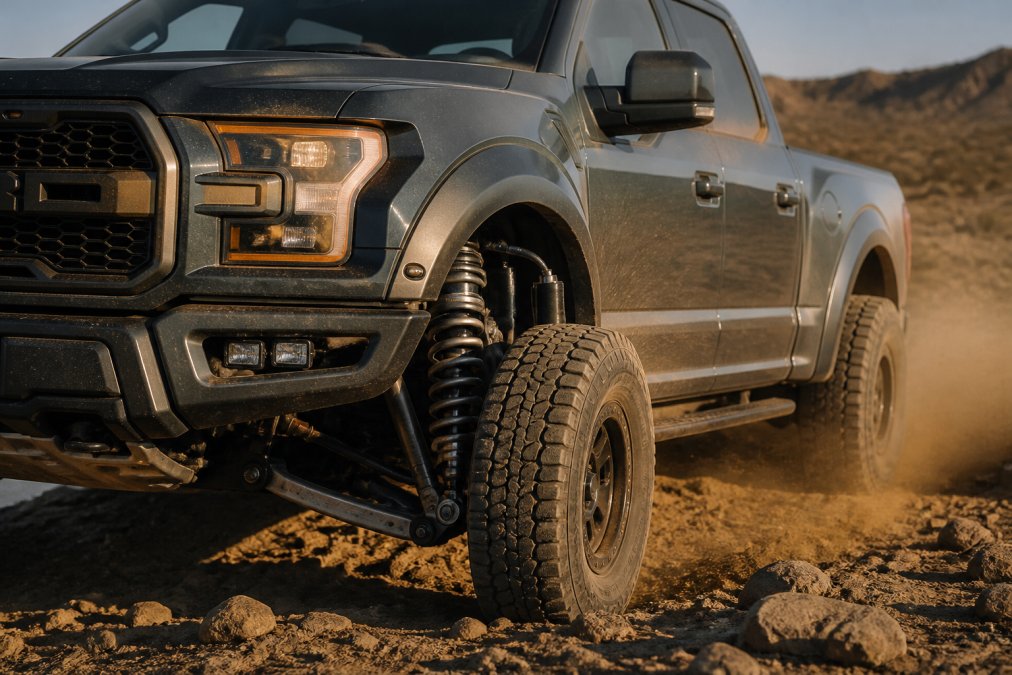
- Fox 3.0 Coilovers for the Ford Raptor: Race-Grade Adjustability
- WULF 3" Lift Kits for the Jeep Wrangler JL: Four Shock Options
- MaxTrac 3" Lift Kit with Fox Shocks: Dual Rate Coil Springs
- Bilstein 5100 Leveling Kits for HD Trucks and Older Rams
- Durable Shocks for Heavy Duty Towing
- Monotube vs Twin-Tube Shocks for Off-Roading
- Frequently Asked Questions
Last Updated: October 2, 2026
How We Picked the Best Off-Road Shock Brands for 2026
The best off-road shock brands for 2026 match damping force to your actual terrain, not the loudest marketing. At THE SUSPENSION SPECIALISTS, we've distributed OEM and performance suspension parts since 2005.
Quick Comparison: Top Off-Road Shock Setups
| Setup | Vehicle Fitment | Price | Best For |
|---|---|---|---|
| Fox 3.0 Coilovers | 2017+ Ford Raptor | $3,499.99 | High-speed desert running |
| WULF 3" Kit + Bilstein | 2018-2026 Jeep Wrangler JL | $914.66 | Balanced daily and trail use |
| MaxTrac 3" Kit + Fox | 2018-2026 Jeep Wrangler JL | $1,500.34 | Load handling, 37" tires |
| WULF 3" Kit + Rancho | 2018-2026 Jeep Wrangler JL | $744.71 | Budget trail builds |
| WULF 3" Kit + Skyjacker | 2018-2026 Jeep Wrangler JL | $744.71 | Entry-level lift |
| WULF 3" Kit + Fox 2.0 | 2018-2026 Jeep Wrangler JL | $1,226.24 | Fox damping on a budget |
| Bilstein Leveling Kits | 2011-2019 HD trucks | $643.69 | Leveling HD trucks |
| Ram 1500 Diesel Kit | 2014-2018 Ram 1500 EcoDiesel | $1,946.09 | Towing and hauling |
Fox 3.0 Coilovers for the Ford Raptor: Race-Grade Adjustability
The Fox 883-06-140 is the most capable front setup we carry for the Gen 2 Raptor, earning that spot through hardware rather than hype. Dual Speed Compression adjusters tune compression and rebound for washboard roads, whoops, or highway miles without swapping parts.

WULF 3" Lift Kits for the Jeep Wrangler JL: Four Shock Options
WULF's 3-inch front, 2-inch rear lift kit for the 2018-2026 Jeep Wrangler JL comes in four shock configurations, making it the most flexible entry point here. Every version ships with dual rate coil springs, brake line extensions, bump stop extensions, and a track bar relocation bracket, and fits up to 35-inch tires.

MaxTrac 3" Lift Kit with Fox Shocks: Dual Rate Coil Springs
MaxTrac built this kit around load handling, our pick for four-door JL owners who carry gear. The 3-inch front, 2-inch rear dual rate coil springs manage weight without ruining the highway ride, and it fits up to 37-inch tires with no fender trimming.
Bilstein 5100 Leveling Kits for HD Trucks and Older Rams
Bilstein 5100 shocks anchor our heavy-duty leveling kits and are why these setups last. The monotube design resists fade better than twin-tube dampers under a loaded truck.
Durable Shocks for Heavy Duty Towing
Durable shocks for heavy duty towing need enough damping force to control a loaded rear end and enough heat capacity to survive long grades without fading. Nitrogen-charged monotubes handle both better than most twin-tubes, since gas pressure keeps oil from foaming under hard work, but the shock is only half the equation. Spring rate and axle weight decide whether it can do its job at all.
The load math most guides skip
A shock does not carry weight, the springs do; the shock controls how fast that weight moves. Add tongue weight, a rooftop tent, or a loaded bed, and the rear springs hold more static load while the rear shocks control more moving mass. Too soft a spring rate and the truck sags, the shock runs deeper into travel, and it overheats faster.
Fitment factors that decide durability
Before ordering any towing-oriented shock, confirm these against your specific truck:
- Rear axle weight rating (GAWR) and your actual scaled rear axle weight loaded.
- Spring rate of the coil or leaf pack, and whether it is progressive or linear.
- Shock travel at ride height, you want enough compression travel left to absorb a loaded bump without bottoming.
- Mounting type (eye-to-eye, stem-to-eye, or bar-pin) and bushing size.
- Lift height, since a lift changes the shock's resting position and effective travel.
A towing-focused setup that holds up
The 2014-2018 Ram 1500 EcoDiesel kit ($1,946.09) is built for exactly this job: MaxTrac coil springs and ductile cast iron lift spindles with Bilstein 5100 shocks front and rear, plus a panhard bar drop bracket and sway bar extension brackets to keep the rear axle located under load. The 5100's monotube construction resists fade better than factory twin-tubes.
Real-world durability: salt, mud, and seal life
What to look for if you tow in mixed conditions:
Fox Racing Shocks 883-06-140 fits 2017+ →
- Hard chrome or nitrided shaft rather than a bare polished shaft.
- Adequate dust boot or shield that keeps grit off the shaft without trapping moisture.
- Finned or remote reservoirs to shed heat on long grades.
- Rebuildable construction, so a failed seal is a service item rather than a replacement shock.
Monotube vs Twin-Tube Shocks for Off-Roading
The best shocks for lifted trucks are usually monotube designs, but the reason is more specific than "monotubes are better": how each design manages heat, gas pressure, and the oil that does the damping work.
The practical difference shows up in three places:
- Heat dissipation. A monotube's single wall exposes more surface area to airflow, so it sheds heat faster during repeated compression cycles. Twin-tubes trap heat in the outer tube and fade sooner on washboard roads, long descents, and loaded grades.
- Mounting orientation. A monotube can be mounted body-up or body-down without trapping gas, which matters on coilover conversions and inverted rear setups. A twin-tube must generally be mounted body-up, or the gas pocket migrates and the damper loses effectiveness.
- Serviceability. Many monotube off-road shocks are rebuildable and revalvable, so you can change shim stacks as your build evolves. Most twin-tubes are sealed and disposable.
| Feature | Monotube | Twin-Tube |
|---|---|---|
| Heat dissipation | Better | Moderate |
| Shock fade resistance | High | Lower |
| Gas pressure | High (commonly 200-360 psi) | Low |
| Mounting orientation | Any | Body-up only |
| Rebuildable / revalvable | Often | Rarely |
| Cost | Higher | Lower |
| Best for | Towing, hard trail use, high-speed terrain | Light trail, street, budget builds |
What valving actually does
Piston diameter and tube design set a shock's capability ceiling, but valving decides how that capability feels. Valving is the shim stack and bleed path controlling oil flow past the piston at a given shaft speed. Low-speed valving (body roll, small bumps) governs ride quality and highway composure; high-speed valving (washboard, whoops) governs how the shock absorbs big hits without spiking force into the chassis.
Coilovers vs. traditional shock and spring setups
A coilover wraps the spring around the shock body with a threaded collar to set ride height and preload, giving adjustable lift without spacers, better spring-to-damper alignment, and easier corner-weighting. A traditional shock-and-spring setup separates the two, simpler, cheaper, easier to service, but ride height is fixed by the spring, so lifting means spacers or new springs.
Frequently Asked Questions
What are the most durable off-road shock brands for 2026?
Durability comes down to construction, not just the name on the box. Look for hard anodized aluminum bodies, stainless steel shafts, and rebuildable designs. Fox 3.0 coilovers use a 3.0-inch hard anodized body, a 7/8-inch hard chrome plated stainless steel shaft, and a finned remote reservoir that helps manage heat on long trails. Bilstein 5100 shocks appear across several heavy-duty and HD truck kits, including the 3"/2" leveling kits for 2011-2019 Silverado and Sierra 2500HD models and the 6.5"/5" Ram 1500 EcoDiesel kit.
How do I choose the right off-road shocks for my truck?
Start with your vehicle platform and how you actually drive. A 2017+ Ford Raptor owner who wants adjustable damping can step up to Fox 3.0 coilovers with Dual Speed Compression adjusters. A Jeep Wrangler JL owner has four shock choices in the WULF 3-inch lift kit line: Bilstein, Rancho RS5000X, Skyjacker Black Max, and Fox 2.0 Performance. Match the shock to your tire size too. The WULF kits fit up to 35-inch tires, while the MaxTrac 3-inch kit fits up to 37-inch tires and needs no cutting or drilling.
What is the difference between monotube and twin-tube off-road shocks?
A monotube shock uses a single cylinder with a floating piston separating the gas charge from the oil, which typically handles heat better during repeated compression cycles on rough terrain. A twin-tube shock uses two cylinders and usually costs less, which suits daily driving and light trails. The trade-off shows up when shocks heat up and damping fades. If you run long washboard roads or tow heavy loads, a monotube or reservoir design holds its damping force longer than a basic twin-tube.
Do I need new shocks if I install a lift kit?
Yes, in most cases. Lifting changes suspension geometry and travel length, so factory shocks may not have enough stroke to control the springs. The kits on this list pair lift springs with matched shocks for that reason. The WULF 3-inch kits for the Jeep JL include front and rear shocks plus brake line extensions, bump stop extensions, and a track bar relocation bracket. The 7"+4" kit for the 2002-2008 Dodge Ram 1500 includes Bilstein 5100 shocks front and rear with new DOT compliant brake lines.
Which off-road shock brands offer the best warranty?
Warranty terms vary by brand and seller, so check the specific listing before buying. The MaxTrac 3-inch kit for the Jeep JL carries a 30-day money back guarantee and a lifetime warranty on parts and kits. Fox 3.0 coilovers and the WULF 3-inch kits include a 30-day money back guarantee.
