

Table of Contents
- Leveling Kit vs Lift Kit: Core Differences
- Leveling Kit Pros and Cons
- Lift Kit Pros and Cons
- Leveling Kit vs Lift Kit Cost Breakdown
- Lift Kit Tire Clearance and Fitment
- Choosing Between Leveling and Lift Kits: Decision Framework
- Frequently Asked Questions
Last Updated: October 9, 2026
Leveling Kit vs Lift Kit: Core Differences
The choice between a leveling kit and a lift kit fundamentally shapes how your truck handles, looks, and performs off-road. At THE SUSPENSION SPECIALISTS, we've helped thousands of truck owners navigate this decision by breaking down exactly what each suspension modification does and where they differ most.

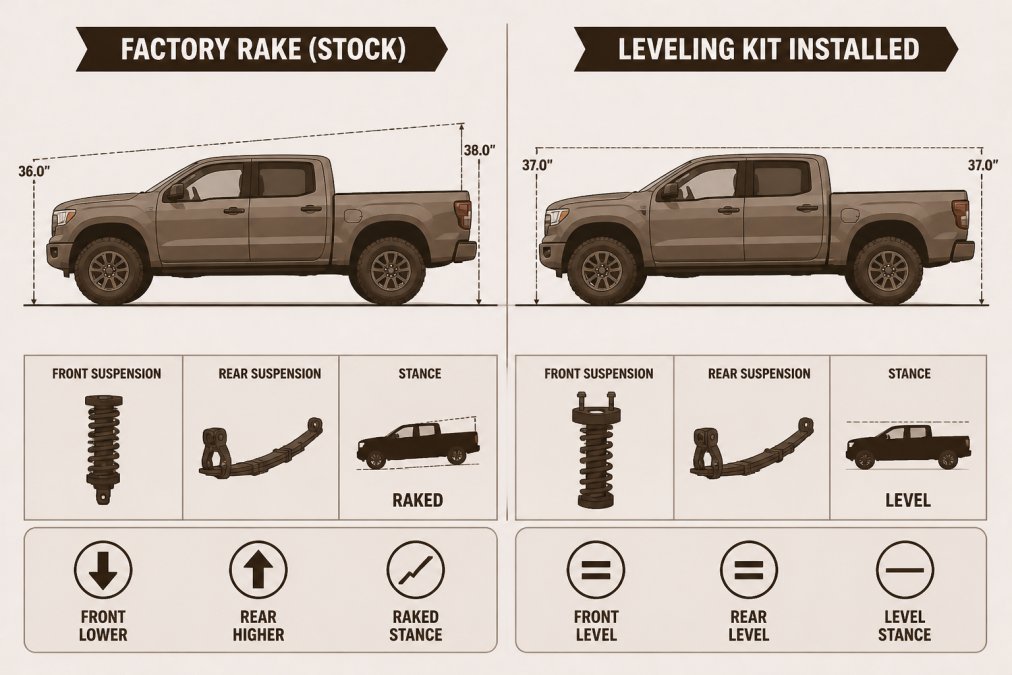
A leveling kit is a suspension modification that raises the front of your vehicle to match or slightly exceed the rear ride height, correcting the factory "nose-down" design that many trucks have from the factory. A lift kit is a more comprehensive suspension upgrade that raises the entire vehicle, both front and rear, to increase ground clearance and off-road capability.
The core difference comes down to intent. Leveling kits solve an aesthetic and functional problem: they eliminate the rake (the downward angle from rear to front) that manufacturers build into trucks for towing and payload capacity. Lift kits go further. They add significant ground clearance, enable larger tire fitment, and improve suspension articulation for serious off-road terrain.
What a Leveling Kit Does
Leveling kits work by adding spacers or coil spring inserts to the front suspension. These components sit between the strut and the spring, effectively pushing the front end upward. The result is a level or nearly level stance from front to rear.
Most leveling kits add between 1 and 3 inches of front height. The spacers are typically made from fabricated steel or composite materials and are bolted directly into your existing front suspension.
The key limitation: leveling kits don't change your vehicle's overall ground clearance much. You're correcting the stance, not dramatically lifting the truck. If your truck sits 8 inches from the ground to the lowest point, a 2-inch leveling kit gets you to roughly 10 inches, an improvement, but not a transformation.
What a Lift Kit Does
A lift kit raises both the front and rear suspension, typically by 2 to 6 inches or more. Unlike leveling kits, lift kits fundamentally change your suspension geometry. They use longer springs, shocks, struts, and control arms to increase wheel travel and articulation.
Lift kits come in two main types: suspension lifts and body lifts. Suspension lifts replace or modify the springs, shocks, and related components. Body lifts stack spacers between the frame and the body to create clearance without touching the suspension itself. Most serious truck owners choose suspension lifts because they improve handling and off-road performance, while body lifts are purely aesthetic.
The advantage is dramatic ground clearance and tire fitment. A 4-inch suspension lift can accommodate tires 2 to 3 sizes larger than stock. This opens up genuine off-road capability: better approach angles, departure angles, and breakover angles for climbing obstacles.
The tradeoff is complexity and cost. Lift kits require more labor. They may affect your vehicle's warranty, change your ride quality, and require alignment adjustments after installation. Taller vehicles also have a higher center of gravity, which affects highway stability and handling if not properly tuned.
Leveling Kit Pros and Cons
Leveling kit pros and cons vary depending on your use case, but the pattern is consistent: they're ideal for correcting factory design without major expense or complexity.
Pros of leveling kits:
Leveling kits are budget-friendly. Most kits from THE SUSPENSION SPECIALISTS start around $29.55 for adjustable spacer systems and go up to $90.06 for fabricated steel options, depending on your vehicle.
They preserve ride quality. Since you're only adjusting the front to match the rear, the suspension geometry stays close to stock.
They're reversible. If you decide you want to remove a leveling kit later, you simply unbolt the spacers and return to factory height.
They solve the aesthetic problem cleanly. Factory rake looks awkward to many truck owners.
Cons of leveling kits:
Ground clearance gains are modest. You're not gaining much real-world clearance for off-road use. If ground clearance is your priority, a leveling kit falls short.
Tire fitment is limited. A 1 to 2-inch leveling kit typically allows only slightly larger tires, maybe 1 size up from stock.
They don't improve suspension articulation. Your truck's wheel travel and articulation stay the same. For serious off-roading, this is a significant limitation.
Front-end wear may increase slightly. Leveling kits change suspension angles, which can accelerate wear on front-end components like ball joints and tie rods if not properly maintained.
Lift Kit Pros and Cons
Lift kit pros and cons tell a different story: greater capability at the cost of complexity and long-term maintenance.


Pros of lift kits:
Significant ground clearance gains. A 4-inch suspension lift can add 4 to 6 inches of real-world clearance depending on your specific suspension geometry.
Larger tire fitment. Lift kits enable tire upgrades that dramatically improve off-road traction and aesthetics.
Improved suspension articulation. Quality lift kits use longer shocks and springs that allow greater wheel travel.
Better off-road handling. When properly installed, lift kits improve your vehicle's ability to navigate technical terrain.
Cons of lift kits:
Higher cost and complexity. Lift kits are expensive. A quality 2.5" front leveling lift kit from THE SUSPENSION SPECIALISTS with adjustable track bar and shock extenders runs $366.13 to $398.31.
Ride quality changes. Lift kits alter suspension geometry in ways that affect daily driving. Your truck may feel bouncier, noisier, or less composed on the highway.
Warranty concerns. Many manufacturers void or limit warranty coverage on lifted vehicles.
Alignment and maintenance complexity. Lifted trucks require more frequent alignment checks and suspension maintenance. Shocks wear faster under the stress of increased articulation.
1" Front Leveling Lift Kit Spacers For 2007-2024 Chevy Silverado GMC Sierra 1500 →
Legal and safety implications. Some jurisdictions have restrictions on vehicle height or suspension modifications.
Leveling Kit vs Lift Kit Cost Breakdown
Understanding the true cost of each option requires looking beyond the kit price alone. Installation, maintenance, and long-term wear all factor into the real expense.
| Cost Factor | Leveling Kit | Lift Kit |
|---|---|---|
| Kit Price | $29.55-$90.06 | $366.13-$398.31 |
| Professional Installation | $150-$300 | $600-$1,200 |
| Alignment & Setup | $100-$200 | $150-$300 |
| Annual Maintenance | $50-$150 | $200-$400 |
| Shock/Strut Replacement (5 years) | $300-$600 | $800-$1,500 |
| Total 5-Year Cost | $800-$1,500 | $2,500-$4,000+ |
Leveling kits are the budget option. Even with professional installation and maintenance, you're looking at under $1,500 over five years. This makes them ideal for owners who want to improve appearance and correct factory rake without breaking the bank.
Lift kits demand a larger initial investment and ongoing maintenance costs. The gap widens if you're running aggressive tires or frequent off-road use, which accelerates component wear. However, if off-road capability is your priority, the cost is justified by the performance gains.
One hidden cost: insurance and fuel economy. Lifted trucks sometimes face higher insurance premiums, and the increased aerodynamic drag and weight can reduce fuel economy by 1 to 3 miles per gallon.
Lift Kit Tire Clearance and Fitment
The relationship between lift height and tire fitment is not always straightforward. Many truck owners assume a 2-inch lift allows 2 inches more tire diameter, but suspension geometry complicates this.
A leveling kit typically allows 1 to 2 sizes larger in tire diameter, roughly 1 to 2 inches. A 2-inch leveling kit doesn't provide a full 2 inches of tire clearance because of how suspension geometry works. The lift is not a 1:1 ratio with tire clearance.
Lift kits provide more predictable tire fitment. A 4-inch suspension lift generally accommodates tires 2 to 3 sizes larger than stock.
Larger tires increase your effective ground clearance. A tire upgrade from 265 to 305 diameter adds roughly 2 inches of clearance at the lowest point of your vehicle, complementing the lift kit's suspension gains.
However, larger tires come with tradeoffs. They reduce fuel economy, increase rotational mass (which affects acceleration and braking), and change your speedometer reading. A 305-diameter tire makes your speedometer read slower than your actual speed.
Fitment also depends on your wheel offset and backspacing. A wheel that's too close to the suspension or too far from the fender can rub even with a lift kit.
Choosing Between Leveling and Lift Kits: Decision Framework
Your choice depends on three core questions: What's your primary use case? What's your budget? How much complexity are you willing to manage?
Choose a leveling kit if:
You drive your truck primarily on pavement and highways. Leveling kits preserve ride quality and don't complicate daily driving.
You want to correct factory rake for appearance. If the nose-down design bothers you, a leveling kit solves it cleanly.
You're budget-conscious. Leveling kits cost a fraction of lift kits and require minimal maintenance.
You plan to keep your truck's warranty intact.
You're a DIYer with basic mechanical skills.
Choose a lift kit if:
Off-road performance is your priority. Lift kits deliver the ground clearance, tire fitment, and suspension articulation that serious off-roading demands.
You plan to run significantly larger tires. If your goal is 305-diameter tires or larger, a lift kit is necessary.
You're willing to invest in long-term maintenance. Lifted trucks require more frequent care.
You understand the tradeoffs. Lifted trucks ride differently on the highway, may face warranty issues, and have a higher center of gravity.
You want genuine improvement in approach and departure angles. If you're tackling rocky terrain, water crossings, or steep grades, a lift kit is the right tool.
THE SUSPENSION SPECIALISTS carries both options for popular truck platforms. Our 1" Front Leveling Lift Kit Spacers for Chevy Silverado and GMC Sierra start at $29.55 for owners seeking simple correction.
The real choice between a leveling kit and a lift kit comes down to honesty about how you use your truck.
At THE SUSPENSION SPECIALISTS, we've been helping truck owners make this decision since 2005.
Frequently Asked Questions
What is the main difference between a leveling kit and a lift kit?
A leveling kit raises only the front of your truck by 1 to 3 inches to match the factory rake (the slight nose-down angle most trucks have). A lift kit raises the entire vehicle, front and rear, by 2 to 8 inches or more. Leveling kits correct factory design quirks, while lift kits add dramatic height for ground clearance and off-road capability. Your choice depends on whether you want a subtle stance correction or serious elevation for tires and terrain.
Does a leveling kit affect ride quality or handling?
Leveling kits typically have minimal impact on ride quality because they use spacers or coil spring adjustments that don't drastically alter suspension geometry. Most owners report no noticeable difference in daily driving comfort. Lift kits, especially larger ones, can stiffen the ride and change handling characteristics because they alter suspension angles more significantly.
How much does a leveling kit or lift kit cost?
Leveling kits range from $30 to $400, depending on lift height and components. For example, a 1-inch adjustable strut spacer kit for a 2007-2024 Chevy Silverado costs $29.55, while a 2.5-inch kit with track bar and shock extenders for a Ford F250 Super Duty runs $398.31. Lift kits typically cost $200 to $1,500 or more because they include more suspension components. Budget also depends on whether you install it yourself or pay for professional installation.
Will a lift kit give me enough tire clearance for larger tires?
Yes, lift kits create the clearance needed for larger tires. A 2 to 3-inch lift usually accommodates tires one size larger than stock. A 4 to 6-inch lift can handle tires two or more sizes bigger. Leveling kits alone rarely provide enough clearance for significantly larger tires because they only raise the front. Remember that larger tires also affect speedometer accuracy and fuel economy.
Is a leveling kit better for daily driving than a lift kit?
For most daily drivers, a leveling kit is the better choice. It corrects the factory nose-down stance without dramatically altering ride quality, handling, or fuel economy. Leveling kits are cheaper, easier to install, and less likely to void warranty coverage. Lift kits are better suited for owners who prioritize off-road capability, ground clearance for serious terrain, or a more aggressive appearance.
